About
InRegPep assembler is an online server for modeling peptide aggregates that adopt an in-register, parallel β-sheet architecture. The method generates a set of plausible three-dimensional (3D) aggregate models for amyloid-prone peptides based on the amino acid sequence submitted by the user [1].
The modeling procedure begins with the simultaneous docking of five copies of the peptide with input sequence using the coarse-grained CABS multichain model [2], allowing the spontaneous formation of small aggregates [3,4]. Conformational sampling is both fast and efficient and is guided by aggregation-specific orientation restraints, enabling exploration of a wide range of aggregate geometries. The resulting ensemble typically contains a large number of alternative structures. For a detailed description of the CABS model, see the Q&A section (link).
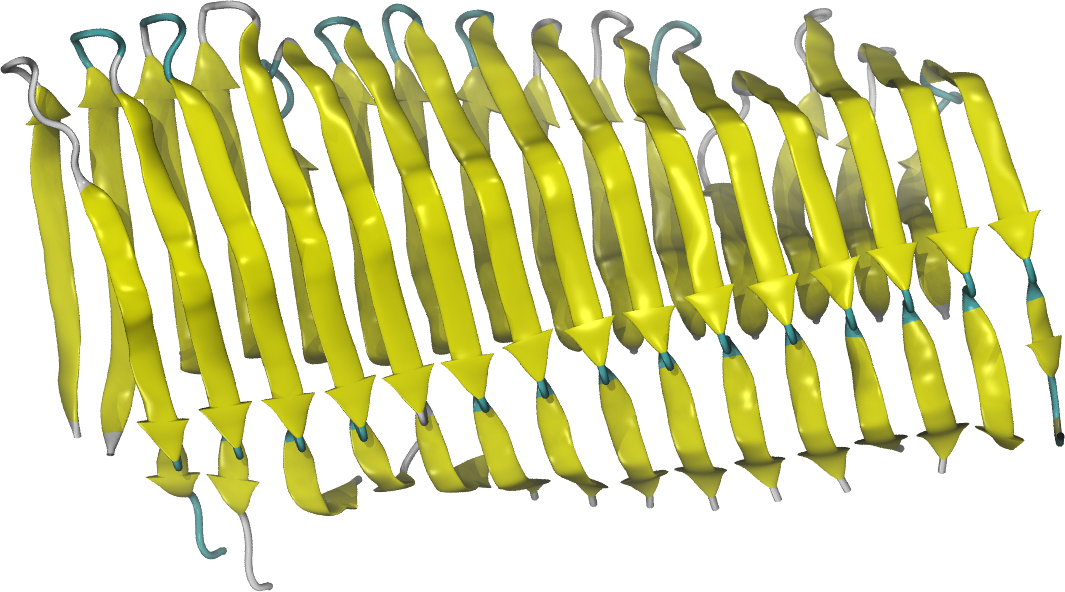
The generated models are ranked using a combination of clustering, energy-based scoring, and symmetry criteria [5]. The top-scoring structures are reconstructed into all-atom representations and further refined using molecular dynamics (MD) simulations. Model quality is evaluated based on conformational stability and MD-derived structural parameters. Finally, key structural features from the highest-ranked models are used to assemble a short protofilament composed of 15 stacked peptide layers. A detailed description of each modeling stage is provided below.
Modeling pipeline
Input
Input data includes the amino acid sequence of the amyloidogenic peptide and user-defined simulation parameters. Peptide sequences between 10 and 100 amino acids are accepted. Adjustable parameters include peptide secondary structure, number of docking simulations, temperature range, number of Monte Carlo cycles, pH value, and optional restraints mimicking intrachain disulfide bonds.

Distance restraints
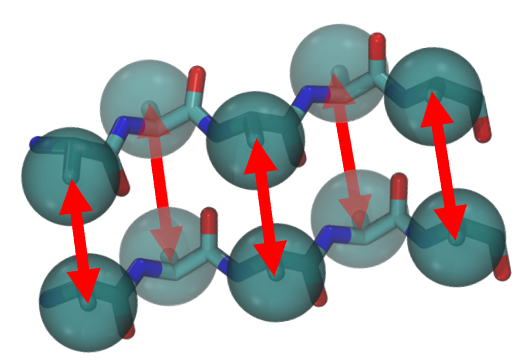
Distance restraints are applied between side-chain united atoms of corresponding residues in neighboring peptide chains to promote an in-register, parallel arrangement. Optional restraints may also be used to mimic intrachain disulfide bonds as specified by the user. The starting conformation is generated based on the submitted amino acid sequence and typically consists of an extended peptide chain.
Prediction of aggregates
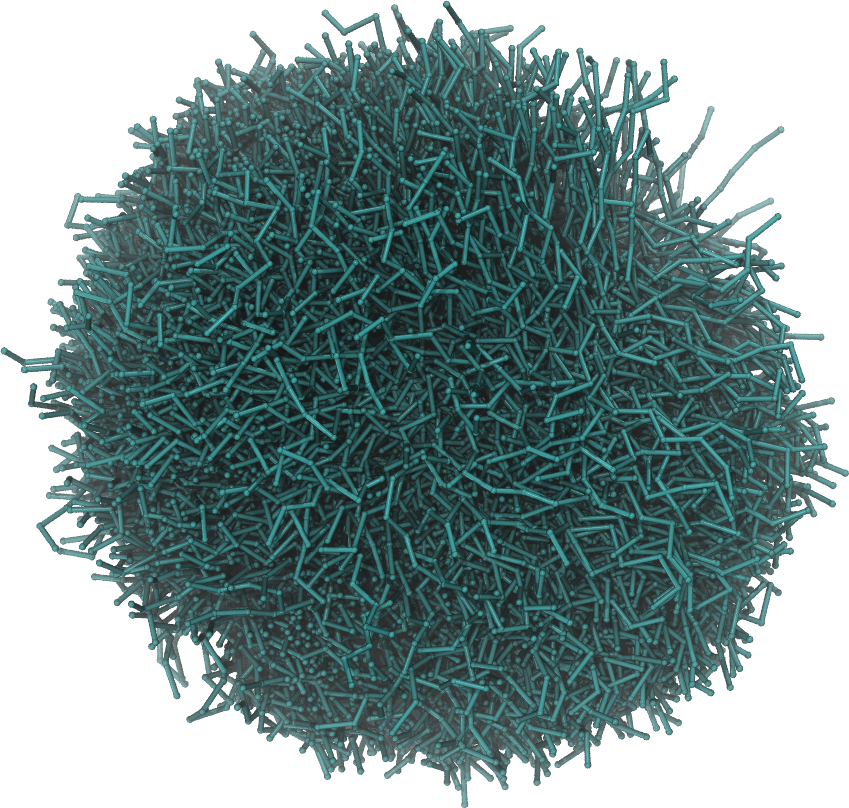
Five identical peptides are docked simultaneously to form aggregates. Simulations are performed using the CABS multimer coarse-grained model, enabling efficient exploration of conformational space. This process generates a large ensemble of plausible aggregate structures represented in Cα-trace format. During the docking simulations, all interacting peptides remain fully flexible.
Model selection
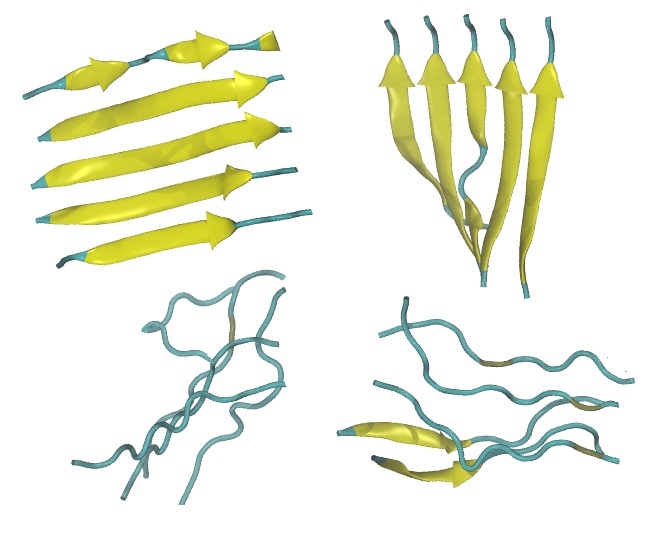
Twenty representative aggregate structures, each consisting of five identical peptides in Cα-trace representation, are selected from a pool of up to 1,000,000 generated models. Selection is based on energy criteria and structural symmetry (quantified using the pcaRMSD parameter), as well as clustering methods.
Model reconstruction and optimization
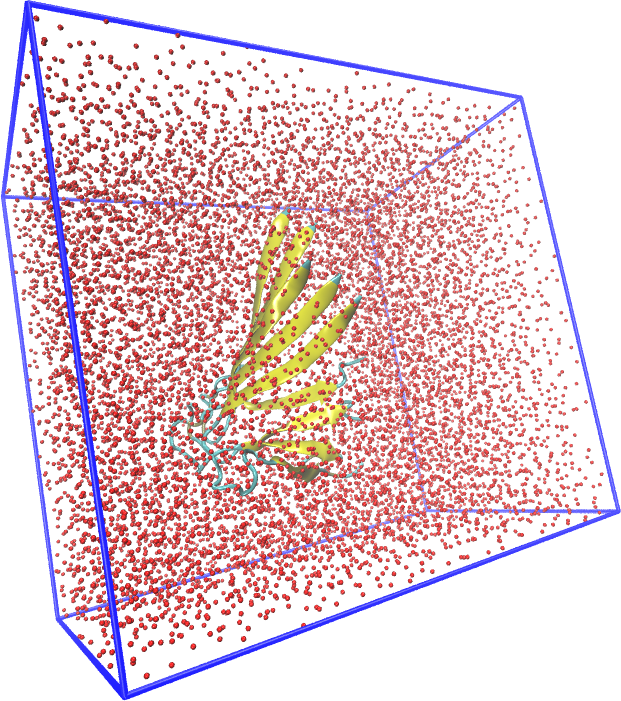
Selected aggregate models are converted into all-atom representations and subsequently refined through geometry optimization, including energy minimization. The refined structures are then subjected to molecular dynamics simulations in explicit solvent.
Selection of top scoring models
For the final aggregate structures, the top 10 scoring models are selected based on structural properties derived from MD trajectories. Evaluation criteria include conformational stability, intermolecular contact patterns, preservation of secondary structure, and the translational symmetry of interacting peptides within the aggregate (pcaRMSD). The server provides plots of RMSD, per-residue RMSF, pcaRMSD (including CABS energy vs. pcaRMSD across docking trajectories), β-sheet content, and interlayer contact data. Each aggregate model is classified as either “plausible” or “unstable.”

Protofilament assembly
For models classified as “plausible”, protofilaments consisting of 15 peptides are assembled based on structural regularities observed in predicted aggregates. The peptide from the central layer is used as the building block for protofilament assembly. Successive layers are generated along the protofilament’s long (Z) axis by replicating this peptide and positioning each copy using a transformation matrix derived from the aggregate structures. The resulting protofilament model is then subjected to a geometry optimization procedure.
References:
- Puławski W., Niewieczerzał S., Koliński A., Firlik G., and M. Koliński.InRegPep: a web server for modeling of parallel beta-sheet fibrillar aggregates of amyloidogenic peptides, Front. Mol. Biosci. 2026 (in press).
- Kurcinski, M., A. Badaczewska-Dawid, M. Kolinski, A. Kolinski, and S. Kmiecik, Flexible docking of peptides to proteins using CABS-dock. Protein Sci, 2020. 29(1): p. 211-222.
- Puławski, W., A. Koliński, and M. Koliński, Integrative modeling of diverse protein-peptide systems using CABS-dock. PLOS Computational Biology, 2023. 19(7): p. e1011275.
- Koliński, M., R. Dec, and W. Dzwolak, Multiscale modeling of amyloid fibrils formed by aggregating peptides derived from the Amyloidogenic fragment of the A-chain of insulin. International journal of molecular sciences, 2021. 22(22): p. 12325.
- Puławski, W., A. Koliński, and M. Koliński, Multiscale modeling of protofilament structures: A case study on insulin amyloid aggregates. International Journal of Biological Macromolecules, 2025. 285: p. 138382.